JinjunGao Lab

AI + Proteomics

Welcome to the fascinating world of proteome!

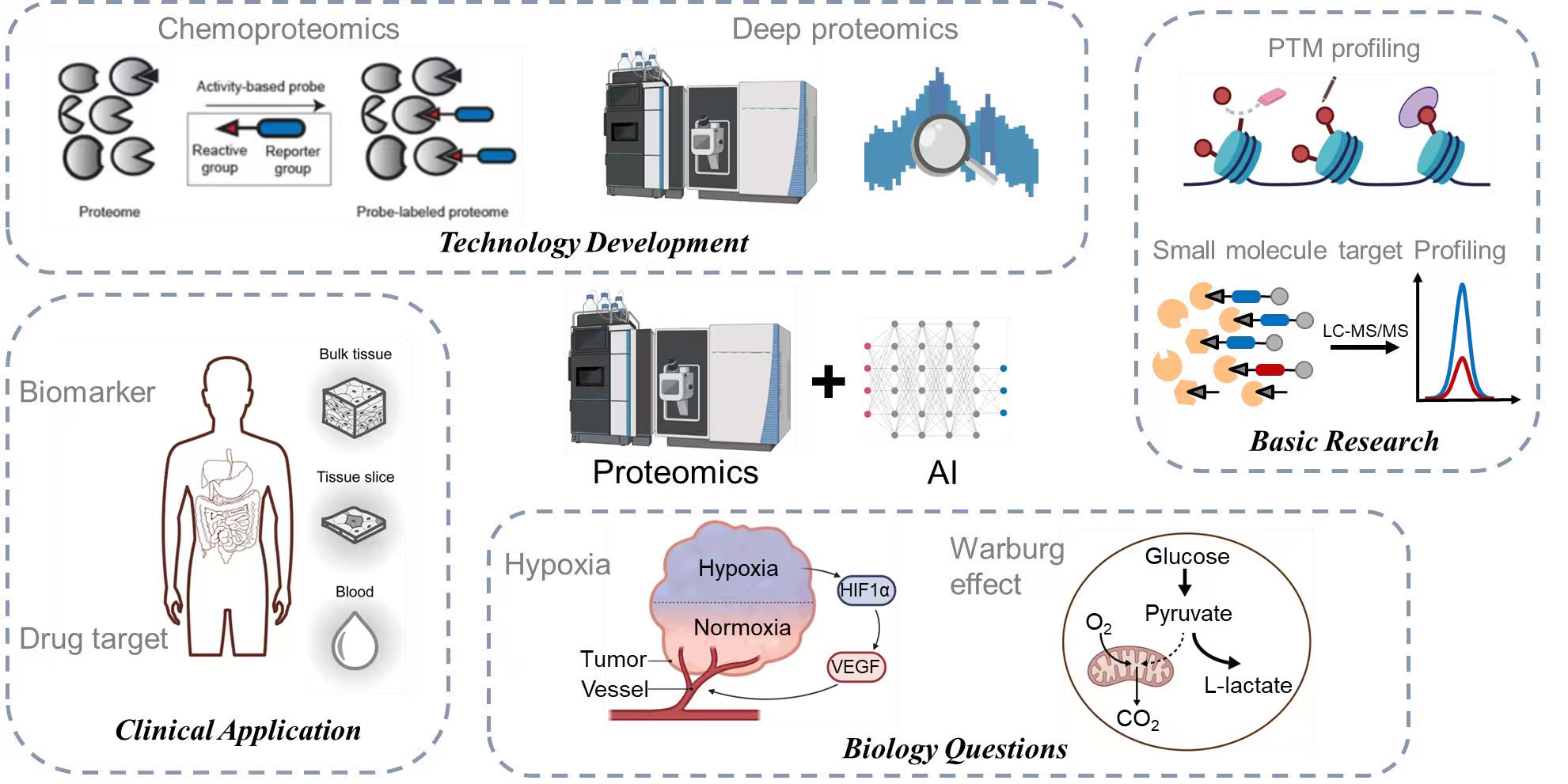
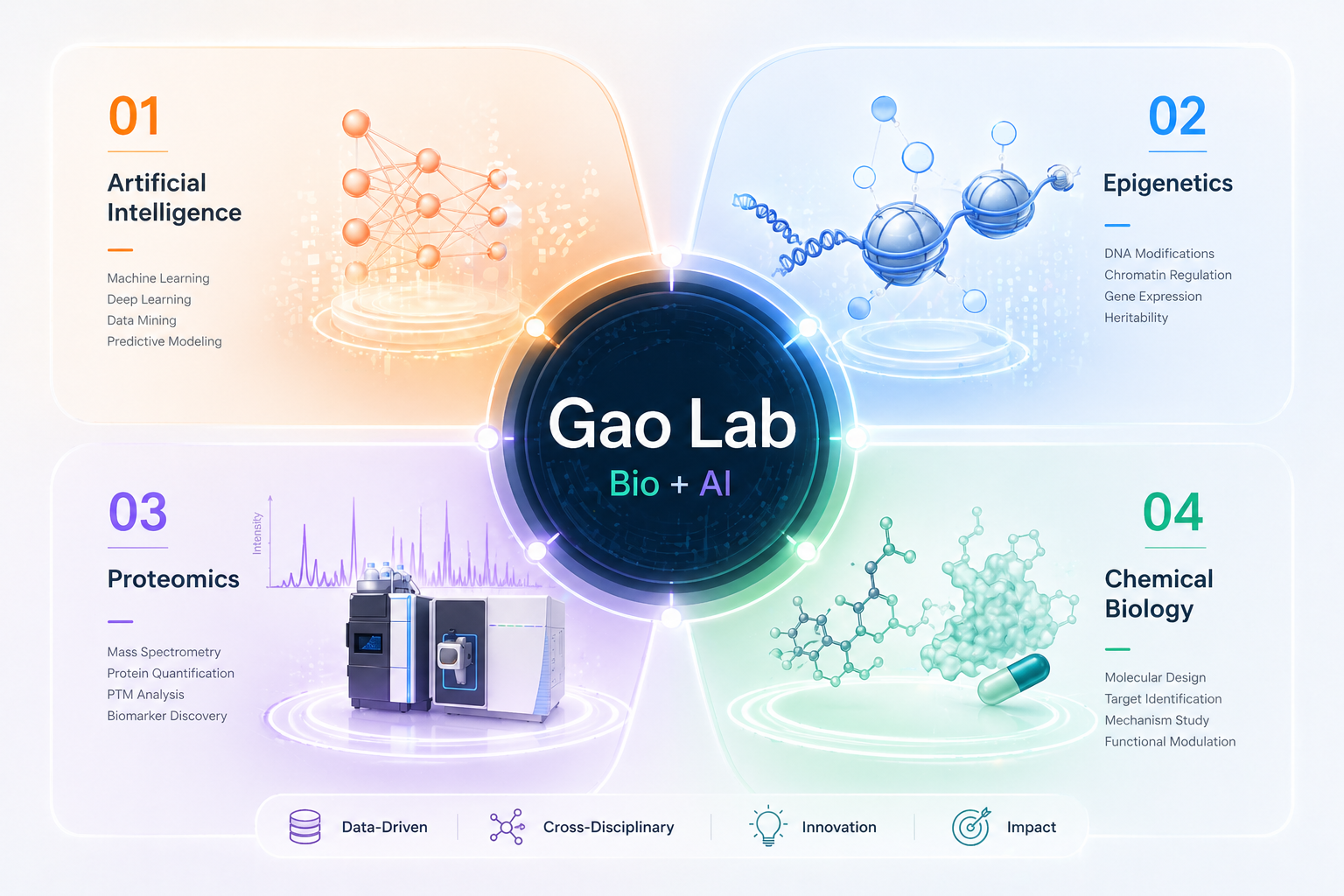
Our work lies at the intersection of chemistry and biology, spanning diverse fields including chemical biology, biochemistry, computational biology, epigenetics and cancer biology. Our mission is to explore the complex cellular landscape, revealing insights into clinical markers and drug targets.
Gao Lab Research Overview

Computational Tools

开源算法与预测平台:CIMAGE2.0、CHiMA、SESTAR++,助力蛋白质组学数据分析。

Join the Team

We are looking for motivated PhD students and Postdocs.
Jinjun Gao

Email

gaojinjun#pku.edu.cn

Office

Room 210, Building F-East

Institution

PKUSZ · SCBB

Principal Investigator

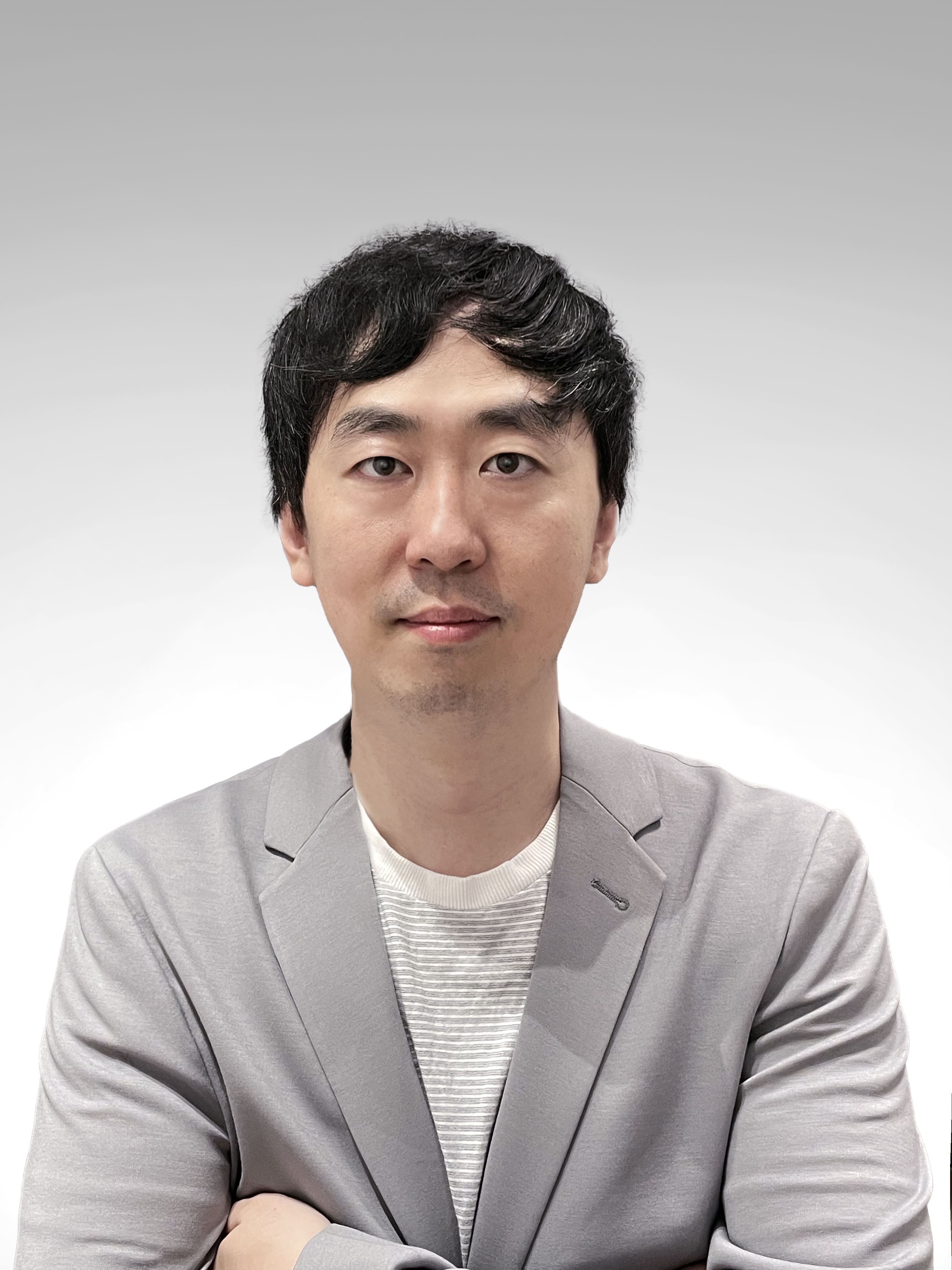
Jinjun Gao

Assistant Professor

Dr. Gao is a tenure-track assistant professor and principal investigator at the School of Chemical Biology & Biotechnology, Peking University Shenzhen Graduate School. He specializes in chemoproteomics and computational proteomics. During his Ph.D. at Peking University, he developed several innovative methods including SESTAR, CIMAGE, and rdTOP-ABPP.

Following his Ph.D., Dr. Gao pursued postdoctoral training at The University of Chicago. His research clarified that the predominant form of lactylation is L-lactylation, a discovery important for the lactylation field and a potential hypoxia biomarker. His work has been featured in Nature, Nature Chemical Biology, PNAS, and ACS Central Science.

Research Interests

  • Chemoproteomics
  • Computational Proteomics
  • Protein PTMs
  • Methodology Development
  • AI for Science

Education

Postdoctoral Fellow

The University of Chicago

2019 – 2024

Ph.D. in Chemical Biology

Peking University

2013 – 2019

Our Team

Lab Members

Administrative Staff

Zhang Jiayi
Zhang, Jiayi

张嘉艺

Admin Assistant

Postdoctoral Fellows

Dong Mochen
Dong, Mochen

董沫辰

Postdoc · 2025

Gao Minli
Gao, Minli

高敏莉

Postdoc · 2025

Graduate Students

Jiang Kaiwen
Jiang, Kaiwen

江凯雯

Ph.D. · 2023

Li Rui
Li, Rui

李蕊

Ph.D. · 2024

Wang Yuanhao
Wang, Yuanhao

王元昊

Ph.D. · 2025

Chen Hanyu
Chen, Hanyu

陈涵宇

Ph.D. · 2025

Guo Yudi
Guo, Yudi

郭宇迪

Master · 2025

Research Assistants

Li Tong
Li, Tong

李彤

RA · 2024

Lu Ying
Lu, Ying

卢颖

RA · 2024

Rong Zixin
Rong, Zixin

戎子昕

RA · 2024

Rui Miao
Rui, Miao

苗瑞

RA · 2025

Ge Jinbao
Ge, Jinbao

葛金宝

RA · 2025

Our vision

Research

We focus on advancing proteomic technologies to unlock deeper insights into protein post-translational modifications (PTMs). By combining cutting-edge chemical tools with AI, we explore cellular mechanisms to identify next-generation biomarkers and drug targets.

01

AI-Driven Proteomics Platform

Developing AI platforms to discover and predict novel post-translational modifications of proteins at scale.

02

Mechanism & PTM Functional Studies

Focusing on lysine lactylation and targeting lactylation pathways for cancers and neurodegenerative diseases.

03

AI-Based Clinical Research

Exploring disease markers and drug targets through AI-enhanced clinical proteomics toward precision medicine.

Systematic Approach

Research Framework

Research Diagram

Selected Works

Publications

(# co-first author, * corresponding author)

Selected Highlights

Dynamic investigation of hypoxia-induced L-lactylation.

Jinjun Gao, Ruilong Liu, Kasturi Chakraborty, Xinlei Sheng, Chang Han, Lev Becker, Yingming Zhao*.

Proc Natl Acad Sci U S A. 2025;122:e2404899122

Lysine L-lactylation is the dominant lactylation isomer induced by glycolysis.

Di Zhang*, Jinjun Gao#, Zhijun Zhu, Qianying Mao, Zhiqiang Xu, et al., Yingming Zhao*.

Nature Chemical Biology. 2024 Jul 19. doi:10.1038/s41589-024-01680-8

Identification of 113 new histone marks by CHiMA, a tailored database search strategy.

Jinjun Gao, Xinlei Sheng, Jianfeng Du, Di Zhang, Chang Han, Yue Chen, Chu Wang*, Yingming Zhao*.

Science Advances. 2023, 9, eadf141

Selenium-Encoded Isotopic Signature Targeted Profiling.

Jinjun Gao#, Fan Yang#, Jinteng Che, Yu Han, Yankun Wang, Nan Chen, Daniel W. Bak, Shuchang Lai, Xiao Xie, Eranthie Weerapana, Chu Wang*.

ACS Central Science. 2018. 4:960–970

Full Chronology

2023
Lysine Catabolism Reprograms Tumour Immunity through Histone Crotonylation.

Huairui Yuan, Xujia Wu, ... Jinjun Gao, et al., Jeremy Rich*.

Nature. 2023.

2022
Class I Histone Deacetylases (HDAC1–3) are Histone Lysine Delactylases.

Carlos Moreno-Yruela#, Di Zhang#, Wei Wei, Michael Bæk, Jinjun Gao, et al., Yingming Zhao*.

Science Advances. 2022. 8:eabi6696.

Structural insights into p300 regulation and acetylation-dependent genome organization.

Ziad Ibrahim, ... Jinjun Gao, et al., Daniel Panne*.

Nature Communications. 2022. 13:7759.

Quantifying Turnover Dynamics of Selenoproteome by Isotopic Perturbation.

Huan Tang#, Guogeng Jia#, Jinjun Gao, Fan Yang, Ziyao Tang, Yuan Liu, Chu Wang*.

Analytical Chemistry. 2022, 94, 27, 9636–9647.

An accelerated and optimized algorithm of selenium-encoded isotopic signature targeted profiling for global selenoproteome analysis.

Guogeng Jia, Jinjun Gao, Fan Yang, Tianyu Feng, Chu Wang*.

Methods in Enzymology. 2022. 662:241–258.

2021
CIMAGE2.0: An Expanded Tool for Quantitative Analysis of Activity-based Probe Profiling (ABPP) Data.

Jinjun Gao#, Yuan Liu#, Fan Yang, Xuemin Chen, Benjamin F. Cravatt, Chu Wang*.

Journal of Proteome Research. 2021.

Histone lysine methacrylation is a dynamic post-translational modification regulated by HAT1 and SIRT2.

Kyle Delaney, Minjia Tan, Zhesi Zhu, Jinjun Gao, Lunzhi Dai, et al., Yingming Zhao*.

Cell Discovery. 2021. 7(1):122.

2018
A Dimethyl-Labeling-Based Strategy for Site-Specifically Quantitative Chemical Proteomics.

Fan Yang#, Jinjun Gao#, Jinteng Che, Guogeng Jia, Chu Wang*.

Analytical Chemistry. 2018. 90:9576–9582.

A Quantitative Chemoproteomic Platform to Monitor Selenocysteine Reactivity within a Complex Proteome.

Daniel W. Bak*, Jinjun Gao, Chu Wang, Eranthie Weerapana*.

Cell Chemical Biology. 2018.

Quantitative Profiling of Protein O-GlcNAcylation Sites by an Isotope-Tagged Cleavable Linker.

Ke Qin#, Yuntao Zhu#, Wei Qin, Jinjun Gao, Xuan Shao, et al., Xing Chen*.

ACS Chemical Biology. 2018, 13, 1983–1989.

Quantitative Profiling of Protein Carbonylations in Ferroptosis by an Aniline-Derived Probe.

Ying Chen, Yuan Liu, Tong Lan, Wei Qin, Yuntao Zhu, Ke Qin, Jinjun Gao, et al., Chu Wang*.

Journal of the American Chemical Society. 2018.

2014
RNA-Seq Analysis of Transcriptome and Glucosinolate Metabolism in Seeds and Sprouts of Broccoli.

Jinjun Gao, Xinxin Yu, Fengming Ma, Jing Li.

PLOS ONE. 2014. 9:e88804.

Flg22 Transcriptome Analysis of Arabidopsis thaliana and Changes of Glucosinolate Metabolism Pathway.

Xinxin Yu, Jinjun Gao, Yong Li, Jing Li*.

China Biotechnology. 2014, 34:30–38.

Computational Resources

Software & Tools

CIMAGE2.0

Quantification

Expanded tool for quantitative analysis of activity-based probe profiling (ABPP) data.

CHiMA

Database Search

Tailored database search strategy for comprehensive histone mark analysis.

SESTAR

Targeted Proteomics

Targeted proteomics using selenium's unique isotope distribution to identify low-abundance peptides with high sensitivity.

SESTAR++

GUI Available

Upgraded SESTAR with a user-friendly GUI and a simple guide for data interpretation.

Opportunities

Join the Team

应聘者请将详细个人简历及其他能证明科研能力的相关电子文件合并为 1 个 PDF 发送至 gaojinjun#pku.edu.cn。博士后应聘额外提供 2 位推荐人的联系方式。邮件标题请注明"应聘岗位 + 姓名"。本招聘长期有效。

Please send your CV and supporting documents as a single PDF to gaojinjun#pku.edu.cn. Postdoc applicants should additionally provide contact information for 2 references. Please indicate "Position + Name" in the subject line. This position remains open until filled.

01 · Ph.D. Students

我们通过推荐免试研究生申请考核制两种方式招收博士研究生,具体说明请参考往年招生说明: 推免研究生申请考核制

欢迎感兴趣的同学提前联系我们,并参加北京大学化学生物学与生物技术学院的暑期夏令营进行交流。

02 · Postdoctoral Fellow

应聘条件

  • ·具有强烈的事业心和创新能力,工作认真负责、积极主动,具有良好的学术道德和团队合作精神
  • ·在国内外已获得或即将获得博士学位,背景包括但不限于:化学生物学、有机合成、癌症生物学、植物学等
  • ·具备良好的英文读写能力,能熟练阅读英文文献
  • ·年龄 35 周岁以下,博士期间在国际期刊发表 SCI 论文

岗位待遇

  • ·提供优异科研条件,年薪不低于 35万(其中 12 万免税),并根据工作经验和成果发放科研补助与绩效工资
  • ·博雅博士后项目:协助申请北京大学博雅博士后,总体薪酬超 50 万/年
  • ·协助申请校内人才公寓,租金远低于周边同等级住房;入站可申请一居室,博雅可申请二居室
  • ·出站留深工作,可享深圳市30 万元科研启动经费

03 · Research Assistant

应聘条件

  • ·具有生物学、化学、医学或药学等相关专业的学士或硕士学位,具备相关研究经验
  • ·工作认真负责,诚恳踏实,具备良好的沟通与协作能力
  • ·对化学生物学有浓厚的兴趣和热情,有明确的职业目标

岗位待遇

  • ·提供优异的科研条件
  • ·薪资待遇从优,享有相关保险及公积金,绩效工资根据考核情况确定
  • ·表现优秀者可推荐申请本校博士研究生